Measuring CVT belt wear on an adventure-style scooter instead of waiting for the slip
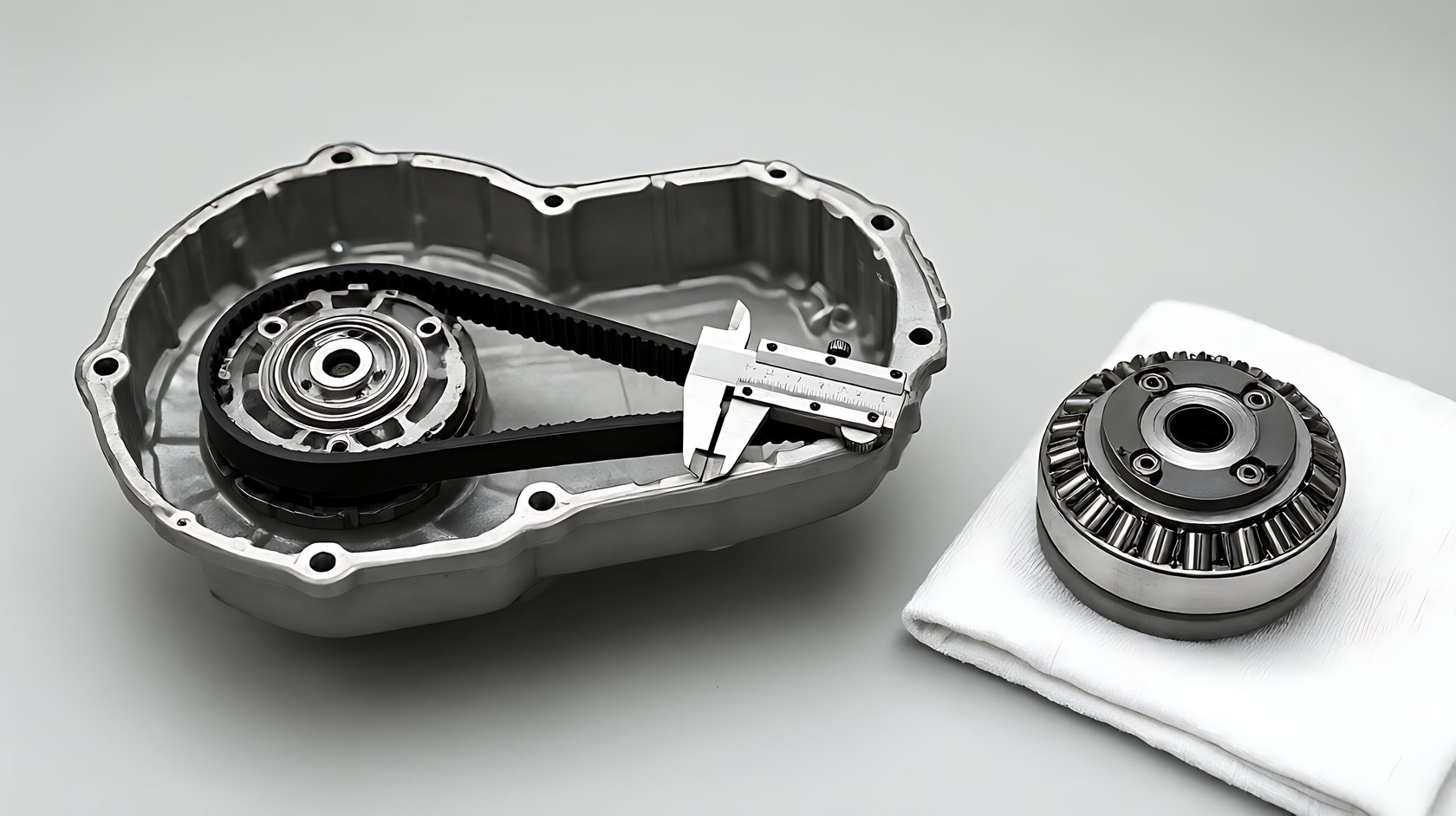
A scooter CVT belt does not fail at once. It loses width, glazes on the flanks, and starts to slip under load at a specific speed that the rider learns to avoid. By the time the rider reports the slip, the belt is usually past the point where measurement would have caught it months earlier.
This note sets out a belt inspection routine for an adventure-style scooter, the class that carries more load, runs higher sustained speeds and therefore wears belts faster than a city scooter. The routine is built around four measurements and one photograph, and it fits into a normal service visit.
1. What the CVT actually wears
A dry centrifugal CVT has four wear surfaces: the belt flanks, the variator faces, the clutch drum and the roller weights. The belt is the cheapest part and the one that fails first, but it usually fails because one of the other three is out of specification. Replacing a belt on worn variator faces buys a few hundred kilometres at best.
That is why the inspection order matters. Measure the belt, then the faces, then the rollers, then the clutch. A belt that is 1.5 mm under width with clean faces points to a different cause than the same belt with polished, dished faces.
2. Belt width: the measurement that predicts failure
Measure the belt width with a micrometer or a vernier at three points around the circumference, avoiding the area where the belt was parked. A new belt is typically 22 to 24 mm wide depending on the model; the service limit is usually 1.5 to 2 mm below nominal. Write all three readings, not the smallest one.
Width matters because the belt sits lower in the variator as it narrows. Lower sitting means a lower effective ratio at rest and a higher ratio at speed, so the engine revs higher for the same road speed. Riders notice this as a scooter that has become noisy and thirsty before they notice a slip.
3. Cord exposure and flank condition
Turn the belt inside out and look for cords showing through the rubber on the inner face. Any visible cord means the belt is finished, regardless of measured width. Photograph it against a scale; a photograph is evidence, a description is an opinion.
Look at the flanks for glazing, which appears as a hard, shiny band with fine cracks across it. Glazing is caused by heat, usually from a slipping belt or a dragging clutch, and it lowers the coefficient of friction exactly where the CVT needs it most.
4. Variator faces and the dish test
Remove the variator and inspect both faces for dishing, grooves and a polished ring at the radius where the belt spends most of its time. A straight edge laid across the face shows dishing in seconds. More than a few hundredths of a millimetre of dishing changes the ratio curve across the whole range.
Run a finger across the face; a face that feels rippled at the belt's mid-radius is worn even if it looks acceptable under light. Ripples come from a belt that has been running slightly too loose or too tight for thousands of kilometres, and they accelerate belt wear in turn.
5. Roller weights and the ramp
Weigh the roller weights and check their diameter at both ends. A roller that has worn flat on one side changes the shift curve; six rollers that have all worn by 0.3 mm change it more. Compare against the specification, and replace as a matched set rather than individually.
Inspect the ramp plate for steps and for polishing where the rollers ride. A ramp with a step makes the transmission shift abruptly at one speed, which riders describe as a clunk or a surge. Cleaning and re-greasing with the specified dry lubricant restores the curve if the ramp is not worn through its coating.
6. Clutch shoes and the drum
Measure the clutch shoe thickness and inspect the drum for glazing and grooves. Shoes worn unevenly mean the clutch engages at an angle, which loads the belt asymmetrically. A drum with a polished band and visible heat discolouration has been slipping, and the belt behind it will be glazed too.
Check the clutch engagement speed against the specification with a tachometer. A clutch that engages 300 rpm late is a clutch that is slipping at take-up, and that slip is the heat source for everything upstream in the CVT.
7. Heat, ventilation and the duct
The CVT case is cooled by air drawn through a duct, often with a foam filter. A blocked duct raises case temperature, softens the belt and accelerates glazing. Check the duct, the foam and the case seal on every inspection, especially on scooters used in dusty or humid conditions.
Measure case temperature after a ten-minute ride at 60 km/h with an infrared thermometer at the case surface. A case that runs above the manufacturer's stated limit needs the duct cleaned before any belt is replaced, or the new belt will fail the same way.
8. Contamination and lubricant discipline
Dry CVTs must stay dry. Oil or grease on the belt flanks reduces friction and produces slip that looks like a worn belt. Check for a leaking output shaft seal and for grease that has migrated from the clutch bearing. A belt that is oily should be replaced, and the leak fixed first.
Use only the specified dry lubricant on the roller ramp. Wet grease collects dust, forms a paste and changes the shift behaviour. Workshops that substitute a general-purpose grease are the reason some scooters shift differently after their first service than before it.
9. The interval that actually works
For a city scooter, a belt inspection at 6,000 km and replacement at 12,000 to 15,000 km is typical. For an adventure-style scooter carrying a rider and luggage at sustained higher speed, shorten both: inspect at 4,000 km, replace by 9,000 to 12,000 km, or earlier if width has dropped 1.5 mm.
Fleet operators should set the interval from measurement, not from the calendar. Track width against kilometres for ten units and the fleet's real wear rate appears. That number is more accurate than any generic table and it survives changes of route and load.
10. Symptoms that point to the CVT rather than the engine
Four symptoms belong to the CVT: a scooter that holds high revs at low speed, a hesitation at a specific road speed, a whine that changes with ratio rather than engine speed, and a top speed that has dropped without any change in load. Each maps to a measurable condition inside the case.
Symptoms that belong to the engine include a rough idle, a misfire under load and a drop in fuel economy without a change in ratio behaviour. Separating these two groups before opening the case saves a diagnostic hour and prevents replacing a belt that was never the problem.
11. Recording the inspection
Record belt width at three points, cord condition, flank glazing, variator dishing, roller weights and diameters, clutch shoe thickness, engagement speed, case temperature, and the decision. Photograph the belt inner face and the variator face with a scale in frame.
The record is what makes a warranty claim or a fleet decision possible. A workshop that can show width dropping from 23.1 to 21.6 mm over 9,000 km does not need to argue about whether the belt was abused; the data answers the question.
12. Storage, winter and the first ride back
A scooter stored for a season develops a belt that has taken a set at one radius. The first ride after storage should be treated as a break-in: moderate load for the first twenty kilometres, then re-measure width and check for a vibration that was not there before storage. A belt that has taken a set often measures within limit and still runs unevenly.
Storage also lets condensation work on the variator faces. A face that has rust freckles will polish them away in the first hundred kilometres and leave a slightly dished surface behind. Inspect before the season starts, not after the first complaint about a noise that appears only at one speed.
Frequently asked questions
Can I replace only the belt? Yes, if every other measurement is in specification. If the variator is dished or the rollers are worn, replacing only the belt shortens the life of the new part.
How do I know a belt is counterfeit? Measure it. Counterfeit belts are usually 0.5 to 1 mm narrow from new, and the cord pattern differs. A new belt that is already below nominal width is not a new belt.
Does the belt need a break-in? Yes. The first 300 km should avoid sustained full throttle and heavy loads, which gives the flanks time to seat against the faces.
Is a slightly glazed belt usable? Only as a temporary measure, and only if width is within limit. Glazing reduces friction, and reduced friction raises heat, which accelerates the glazing.