Reading the first oil sample from a 200–250 cc twin without guessing
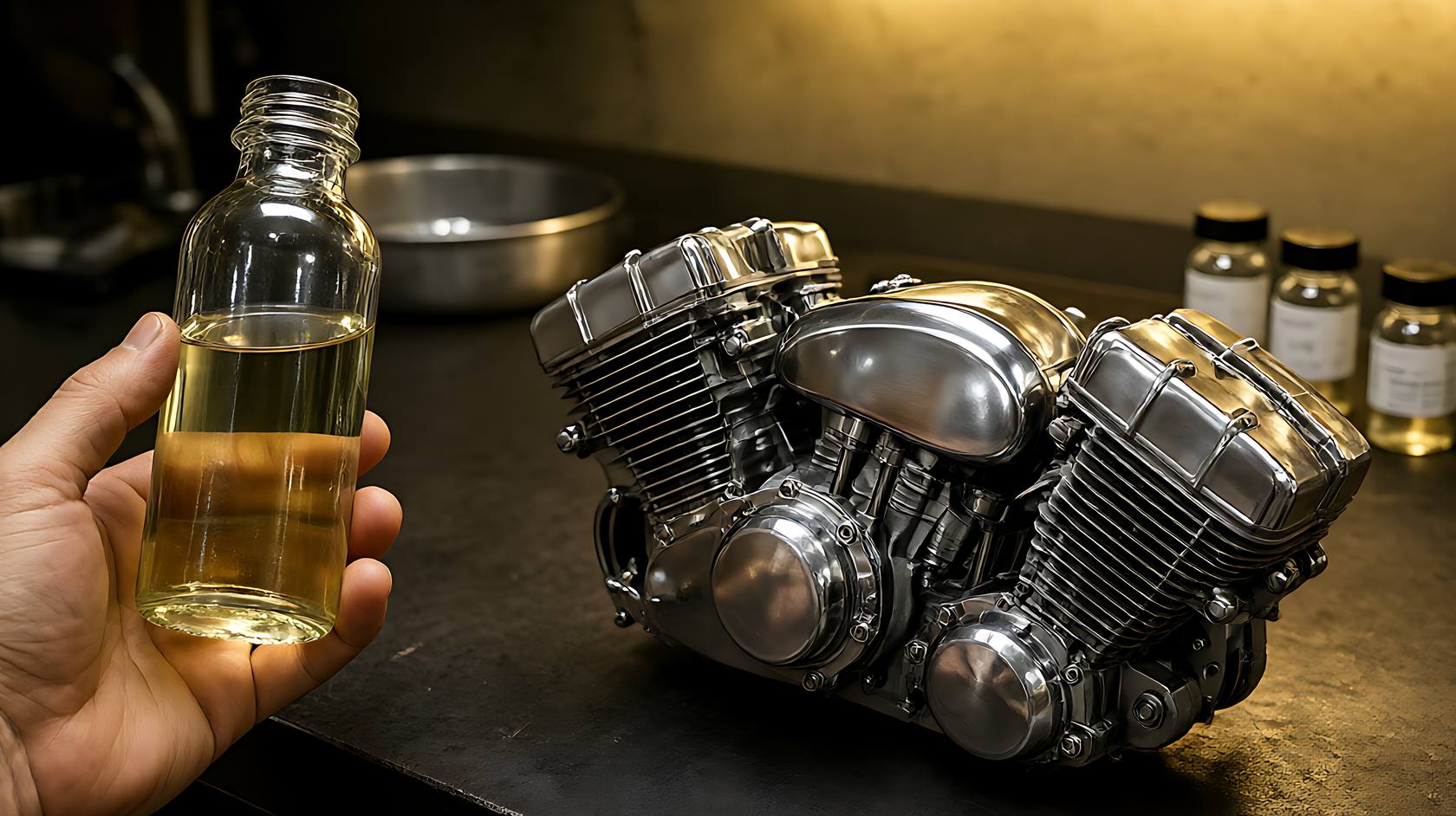
The first oil change on a new engine is the only sample that shows the engine's own break-in, before road dust, fuel dilution and ordinary wear blur the picture. Most dealers drain it, look at the colour, and throw away the most useful diagnostic data the engine will ever produce.
This note describes a workable sampling and interpretation routine for a 200–250 cc parallel twin, the class where break-in wear is highest relative to sump volume and where a single missed defect becomes an oil consumption complaint at 4,000 km. The routine costs one sample bottle and ten minutes.
1. Why the first sample is different
During the first few hundred kilometres, ring lands seat, bearing surfaces bed in and the cylinder liner cross-hatch wears down. The oil carries that metal. Later samples carry a steady-state mix dominated by normal asperity wear, so a fault that is obvious at 500 km becomes invisible at 5,000 km.
The first sample is also the only one taken before the customer's riding style enters the data. A sample at 500 km describes the factory and the assembly line; a sample at 5,000 km describes the rider. If you want to know whether the engine was built correctly, take the early sample.
2. Sampling that produces a usable number
Drain the oil warm, after a ten-minute ride, into a clean container after discarding the first hundred millilitres. Take the sample from the mid-stream, not the first or last of the drain, and cap it immediately. Record the odometer, the oil grade, the sump volume and the ambient temperature on the label.
Do not sample from the filter housing unless the procedure calls for it; the housing holds a concentrated slug of debris that will read as a catastrophic failure. If the engine has a drain plug with a magnet, photograph what is attached to it before wiping it, and weigh the deposit if the workshop has a milligram balance.
3. The metals that matter and what they mean
Iron tracks cylinder, ring and gear wear. Copper tracks bearings, bushings and oil cooler cores. Aluminium tracks piston skirts and, in some engines, the cylinder head casting. Silicon is abrasive dust or gasket material. Tin and lead appear from bearing overlays. Each element has a different story, and a single high number rarely tells it.
Iron alone at 150 ppm in a first sample is ordinary break-in. Iron at 150 ppm with copper at 80 ppm and tin at 15 ppm is a bearing surface that is wearing abnormally, and the engine should come apart before the customer takes delivery. Ratios, not absolute values, drive the decision.
4. Particle count and the filter's job
Particle counting on a first sample is often skipped because the oil is expected to be dirty. It is worth doing anyway, because the size distribution tells you whether the filter is bypassing. A sample with a large population above 20 microns suggests the filter is in bypass, which on a new engine usually means a stuck relief valve or the wrong filter.
Check the filter part number against the engine's bill of materials at the same time. Cross-reference errors at the assembly line are common on shared platforms, and a filter with the wrong bypass pressure will pass debris that the correct filter would hold.
5. Viscosity and fuel dilution
A first sample should sit within one grade step of the specified viscosity at 100 degrees Celsius. A viscosity that has dropped suggests fuel dilution, which on a new engine points to a rich start calibration or excessive idling at the factory. A viscosity that has risen suggests oxidation or a different oil was filled.
Fuel dilution above 2% on a first sample is worth a conversation with the factory, because it affects the running-in of the bore. Flash point testing confirms it, but a viscosity drop plus a fuel smell is usually enough to justify a second sample after 500 km with a fresh fill.
6. When to change the oil, and when to change the engine
The first change belongs at 500 to 1,000 km depending on the manual, and the second at the first scheduled service. If the first sample shows a bearing-metal pattern, change the engine or the affected parts before delivery rather than shortening the interval; a shorter interval does not fix a worn bearing.
Record the decision, not only the result. A file that says 'sample taken, iron 120, copper 12, no action' is useful in a warranty discussion two years later. A file that says 'oil changed' is not evidence of anything.
7. Break-in procedure interacts with the data
Factory break-in procedures vary: some run the engine on a bench for a fixed cycle, some rely on the first owner. Bench-run engines produce a first sample with high iron and low fuel dilution; owner-run engines produce the opposite. Knowing which procedure applies keeps you from misreading a normal sample as a defect.
If the engine was bench-run, ask for the bench oil sample data. A factory that can produce it is a factory that measures; a factory that cannot is a factory whose first sample is your only data, which raises the value of taking it properly.
8. Bench versus field sampling
Bench sampling allows a fixed load, a fixed duration and a fixed oil temperature, which makes results comparable across units. Field sampling is messier but reflects real use. For a first sample, bench data is better for defect detection; for a second sample, field data is better for wear trending.
Do not compare a bench sample with a field sample and call the difference a fault. Normalise by odometer and by load history before drawing a conclusion. Most false alarms in oil analysis come from comparing samples that were taken under different conditions.
9. Building a baseline across a batch
One sample tells you about one engine. Twenty samples from one batch tell you what normal looks like for that production run. Take samples from the first ten and the last ten units of a container, and compare medians rather than means; a single outlier should not move the baseline.
When the median copper for a batch is three times the median for the previous batch, the change is in production, not in the riders. That is a finding worth sending to the factory with the raw data attached, and it is the kind of finding that changes a supplier relationship.
10. The record
One line per sample: chassis number, odometer, date, oil grade, iron, copper, aluminium, silicon, viscosity at 100 degrees Celsius, fuel dilution, particle count above 20 microns, action taken, and who decided. Ten columns, no narrative, searchable later. Anyone who has tried to reconstruct a batch history from memory will recognise why this matters.
Keep the sample bottles labelled and stored for ninety days. If a claim arises, the retained sample can be re-tested by a third party, and a re-test settles arguments that a report alone cannot.
11. What the data cannot tell you
Oil analysis does not measure clearance, ring tension, bore roundness or valve sealing. It indicates trends in wear and contamination. A perfectly normal sample can sit in an engine with a mis-machined bore that will consume oil at 8,000 km. Use the sample as one instrument, not as a verdict.
The complementary measurements are compression, leak-down and a cylinder bore scan on the first unit of a batch. Together with the oil sample they give a picture; separately, each of them is a partial answer that is easy to over-read.
12. What to do with a bad first sample
A bad first sample has three possible responses: stop delivery and inspect, change the oil and re-sample at 500 km, or accept the reading and record the reason. The choice depends on which metal moved. Bearing metals mean stop. Iron alone with a normal ratio pattern means re-sample. Silicon alone usually means the engine was assembled in a dusty area and the filter did its job.
Whatever the response, put the reason in the record in one sentence. A decision without a reason is indistinguishable from a decision that was never made, and the next person to read the file will not know whether the engine was cleared deliberately or by accident.
Frequently asked questions
Is a first oil sample worth the cost on a commuter twin? Yes, if it is taken as a batch routine rather than as an individual inspection. The value comes from the baseline, not the single report.
How much oil do I need? One hundred millilitres is enough for spectrochemical analysis; take two hundred if particle counting is included.
What iron level should worry me? Above 300 ppm in a first sample, or above 150 ppm with a bearing-metal pattern, is worth stopping delivery until the cause is known.
Can I skip the second sample? Not if the first sample showed a trend. The second sample is what turns a single reading into a direction.